AI SEO vs GEO: The Future of Search Optimization Explained
In the rapidly evolving digital landscape, the debate around AI SEO vs GEO is becoming central to how brands approach online visibility. Traditional search optimization is no longer enough. With AI-driven search engines and generative models reshaping how users discover information, businesses must understand both approaches to stay competitive. This is where advanced solutions from Thatware LLP play a transformative role in bridging the gap between classic SEO and next-generation Generative Engine Optimization.
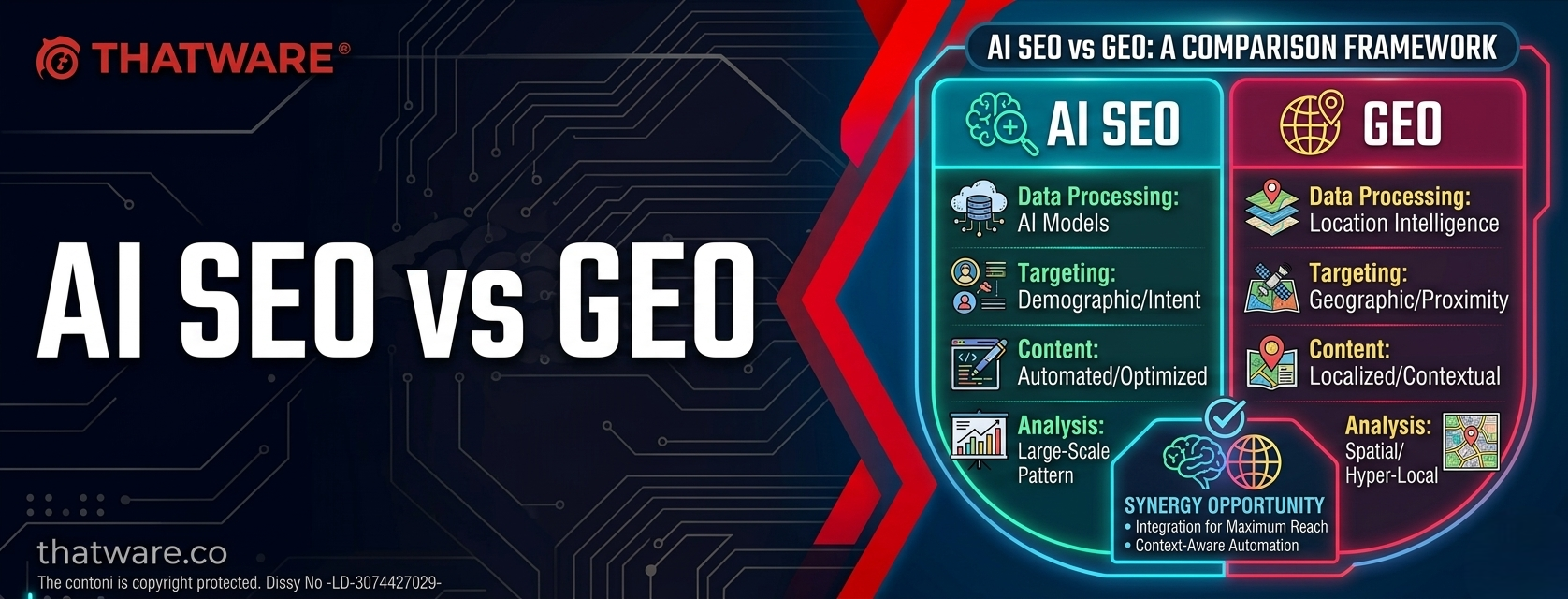
Understanding AI SEO in the Modern Ecosystem
AI SEO refers to the use of artificial intelligence to enhance traditional search engine optimization strategies. Instead of relying solely on manual keyword research and static ranking techniques, AI SEO leverages machine learning, natural language processing, and predictive analytics to optimize content performance.In AI SEO, search engines are not just indexing pages—they are interpreting intent. This means content must be contextually relevant, semantically rich, and aligned with user behavior patterns. AI tools analyze large datasets to identify ranking opportunities, content gaps, and search trends that humans might overlook.For brands like Thatware LLP, AI SEO enables smarter decision-making by automating keyword clustering, optimizing on-page elements, and continuously refining content strategies based on real-time performance data. The goal is not just ranking higher, but delivering precise answers to user queries.
What is GEO (Generative Engine Optimization)?
GEO, or Generative Engine Optimization, represents the next evolution of search strategy. Unlike traditional SEO, GEO focuses on optimizing content for AI-powered search engines such as generative AI models that provide direct answers instead of lists of links.In the context of AI SEO vs GEO, GEO is fundamentally about visibility within AI-generated responses. When users ask questions to AI assistants, chatbots, or generative search engines, GEO determines whether your brand is referenced, cited, or recommended.This requires a shift in strategy. Content must be structured in a way that AI systems can easily understand, extract, and reuse. It emphasizes entity-based optimization, semantic clarity, authoritative sourcing, and deep topical coverage.Thatware LLP specializes in aligning digital assets with GEO principles by ensuring that content is not only search-friendly but also AI-consumable. This increases the likelihood of being featured in generative answers across platforms.
Key Differences Between AI SEO vs GEO
While both strategies aim to improve visibility, the core difference lies in how content is consumed and delivered.AI SEO primarily focuses on ranking in traditional search engines like Google, where users click through links to find information. It is still largely page-based and keyword-driven, although enhanced by AI capabilities.GEO, on the other hand, focuses on AI-driven answer engines where users receive synthesized responses directly. Instead of competing for clicks, brands compete for inclusion in AI-generated narratives.Another key difference is optimization style. AI SEO relies on optimization signals like backlinks, page speed, and keyword relevance. GEO emphasizes structured data, entity recognition, and semantic depth to ensure content is correctly interpreted by AI models.In essence, AI SEO drives traffic, while GEO drives presence within AI-generated intelligence systems.
Why Businesses Need Both AI SEO and GEO
The digital ecosystem is no longer limited to search engines alone. Users are now interacting with voice assistants, AI chatbots, and generative search platforms. This makes the integration of both strategies essential.Relying only on AI SEO limits visibility to traditional search results. Ignoring GEO means missing out on the growing AI answer economy. Businesses that adopt both approaches create a dual-layer visibility system—one for search rankings and another for AI-generated recommendations.Thatware LLP emphasizes this hybrid strategy, ensuring brands remain visible across all digital discovery channels. By combining AI SEO with GEO, businesses can maximize reach, authority, and trust in an increasingly AI-dominated environment.
The Future of AI SEO vs GEO
The future of search is not about choosing between AI SEO and GEO—it is about integrating both into a unified strategy. As AI models become more advanced, search engines will increasingly rely on generative capabilities to deliver personalized, context-aware responses.This means content optimization will shift from keyword-centric models to intent-centric and entity-driven frameworks. Websites that fail to adapt will lose visibility, while those aligned with both AI SEO and GEO will dominate digital ecosystems.Forward-thinking agencies like Thatware LLP are already building frameworks that combine predictive SEO analytics with generative optimization strategies. This ensures long-term visibility in both traditional and AI-powered search environments.
Conclusion
The comparison of AI SEO vs GEO highlights a major transformation in digital marketing. While AI SEO strengthens traditional search performance, GEO ensures visibility in the emerging world of generative AI systems. Together, they represent the future of search optimization.Brands that embrace both will not only rank higher but also become part of AI-generated knowledge ecosystems. With expertise from Thatware LLP, businesses can successfully navigate this shift and secure their place in the next era of search.
#AISEOvsGEO #GenerativeEngineOptimization #ThatwareLLP

.jpg)

Comments
Post a Comment